
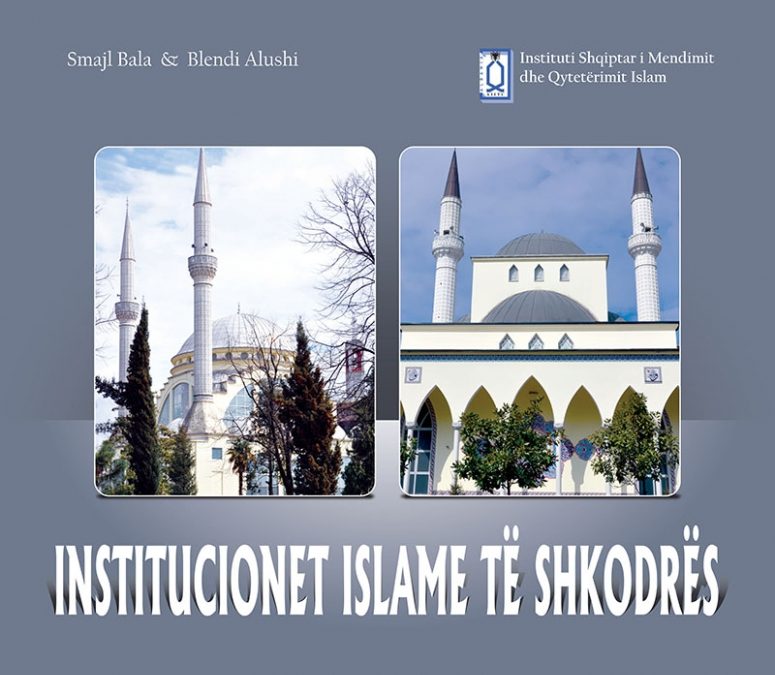
Authors: Smajl Bala and Blendi Alushi
Publisher: AIITC
Year: 2011
ISBN: 978-9928-126-00-9
Faith in God has always accompanied the Albanian people in the suffering they have suffered through the centuries, where the Islamic religion has played a very important role. The Hoxhallars have been promoters of spiritual and social development, being noted for their role as imams in the mosque, as patriotic leaders for the fate of the nation, and even as commanders in the struggles for freedom of the Albanian people throughout history. Many have fallen as martyrs to protect the life, honor and land of this people. Some were esteemed and decorated for their patriotic values, but many were exiled or executed by the communist regime as a result of their great intellectual and spiritual power. This interesting publication by the authors Smajl Bala and Blendi Alushi, helps the Albanian reader to learn more about the life and work of these Islamic Shkodra personalities, with indelible imprints on the history of Islamic faith in the Albanian Areal. The book also mentions the mosques, mosques and madrasas of the district of Shkodra.
Some of the most prominent muftis and pilgrims of the district of Shkodra mentioned in this publication are:
Yusuf Efendi Tabaku (1797-1904)
Derived from a family of Hoxhaars, he completed his theological studies in Istanbul. In addition to the function of mufti, he also performed the function of mderriz in the Qafa madrasa. But he was most notable for his patriotic contribution, activated in protests during the Prizren League period, supported the 1834 uprising and demanded the use of Albanian language in madrasas and mosques. Thanks to his abilities, he was awarded the Ottoman medal “Mexhiti”, and after the advent of democracy, he was decorated by the President of the Republic with the title “Teacher of the People”.
Haxhi Vehbi Ahmet Dibra (1867-1937)
Born in Greater Debar, a family of religious and patriotic traditions. It took the title of Hafiz and adopted the Islamic Shari’ah. Initially he was appointed imam and then the mufti of Dibra. But he was also an ardent patriot in the national cause. In 1909 he was elected President of the Debar Congress, and in 1912 he was appointed Vice-President of the Vlora Assembly, where his hand and Ismail Kemal’s flag were raised in Vlora, proclaiming Independence. He devotedly led the Dibra uprising against the Serbian-Montenegrin invaders. In 1916 he was the initiator of the establishment of the Supreme Shari’ah Court in Shkodra, where he was elected its chairman. from 1923 to 1929 he was president of the Muslim Community of Albania. He fought for the use of the Albanian language and in 1916 enabled the seal of the Supreme Shari’ah court to be written in Albanian letters. The President of the Republic decorated him with the Order of Liberty Medal of the First Class.
Xhemal Hasan Naipi (1887-1955)
It comes from a Shkodra family known for their duty of cadets. He completed his studies in theology in Istanbul. In addition to Kadi and later the Mufti of Shkodra, he was also the chairman of the Education Commission in Shkodra and the general director of the Waqfs of Albania. He showed patriotic values as a delegate to the Congress of Lushnja, as an MP in the Albanian Parliament, as chairman of the Legal Movement. He was decorated by the President of the Republic with the Order of the First Class for patriotic and political activities, as well as with the “Torch of Democracy” medal.
Salih Efendi Myftia (1891-1978)
It comes from a family with a religious tradition. He completed his theological studies in Vlora by the theologian Haxhi Vehbi Dibra. He worked as an imam, director of madrasah and head of Shkodra and Gjakova. It was a perfect example of interfaith tolerance, forging close links with Catholic and Orthodox clergy. He was even the first to connect festive flags and electric lights from the minaret of the Fushe-Cela mosque to the bell tower of the Franciscan church for every religious and national holiday. Released by Victor Emanuel III and exiled to Gjirokastra in 1939. He left Albania for Italy and then for the US where he died.
Haxhi Faik Sheh Qazim Hoxha (1930-2011)
He was a theologian and leader of the Tariqah Tariqah, also a professor at the Tirana Madrasa. Later he started working in the handicraft cooperative in Shkodra. He was arrested and served a prison sentence until 1989. With the change of the system, he is reactivated with religious duties, where the mufti of Shkodra is resolved. He made a remarkable contribution to the reorganization of religious institutions and the construction of new mosques in Shkodra. It also worked for the harmony and close connection between the three religious faiths. He was honored with the title “Honorary Citizen” of Shkodra for his comprehensive contribution.