
Tirana, 17.07.2019
AIITC Academy of Peoples and Culture successfully closed its sixteenth edition. Through this cycle of meetings, the Albanian Institute of Islamic Thought and Civilization aims at enriching Albanian culture with new perspectives and diversified flow from world civilization. The first meeting kicked off in 2012, to go on a long journey, attended by prominent personalities of science, culture and art, both inside and outside Albania, such as writer Abdulatif Arnauti, Arberesh Professor Antonio Belluschi, Dr. Semir Osmanagich, Dr. Dr. Omar Hasan Kasule, Dr. Mehmet Tutuncu, Ambassador of the Republic of Egypt, Mohamed Khalil, Dr. Dr. Rafia Obaid Ghubash, Dr. Muhammad Beshari etc.
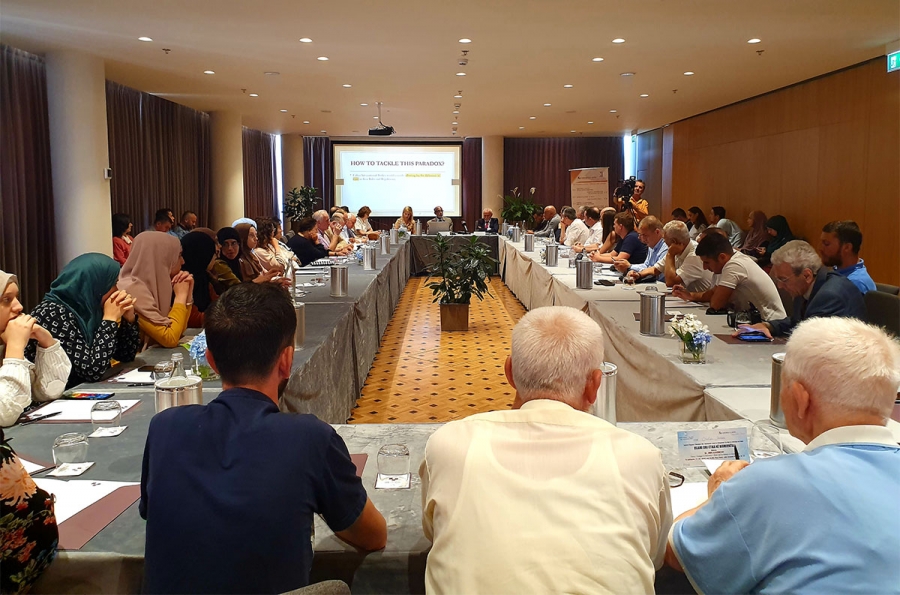
The guest of honor in the 16th edition of the Academy “Peoples and Cultures” was Dr. Amin Kashmeery, Professor of Physiology at King Saud bin Abdulaziz University in Mecca, who delivered a very interesting lecture on “Islam and Ethics in Biomedicine”. Participants in this seminar were prominent intellectuals, representatives of relevant institutions dealing with the topic, medical students and specialists.
The meeting was opened by the Chairman of the Board of Directors of AIITC, Dr. Faruk Borova, who gave a brief presentation of the role and activity of Dr. Kashmeery in the field of Biomedicine. At the focus of his speech, the lecturer focused on the developments that medicine has undergone over the centuries and the need for ethics to be applied by health workers in relation to patients, as well as by researchers in scientific research. Citing examples of mistreatment of prisoners, or patients in psychiatric hospitals, use of sick and poor children for experiments, etc. Dr. Kashmeery noted violations of international guidelines, such as the Human or Patient Rights Charter.
Viewed from the perspective of Islam, Biomedical Ethics makes it possible to choose a middle ground that is more in favor of higher human morality. The lecturer illustrated the interesting data with some of the Qur’anic verses that talk about compassion among people and the correct way of behaving among themselves, which justifies the main purpose of Biomedical Ethics. Dr. Kashmeery came up with the idea of establishing a Global Council on Biomedical Ethics in Islam to include Muslim academics and scholars from around the world.
At the questioning session, following this special and useful lecture, attendees expressed interest in Islam’s view on issues of high public sensitivity, such as organ transplantation, euthanasia, stem cells, artificial insemination, and so on. At the end of this meeting, AIITC handed over to Dr. Amin Kashmeeryt a certificate of gratitude for his participation in the Academy of Peoples and Culture. In the 16 editions carried out so far, AIITC’s Academy of Peoples and Cultures has managed to convey messages of interpersonal understanding, unfolding the relationship between nations and world cultures.